

November 2, 2025
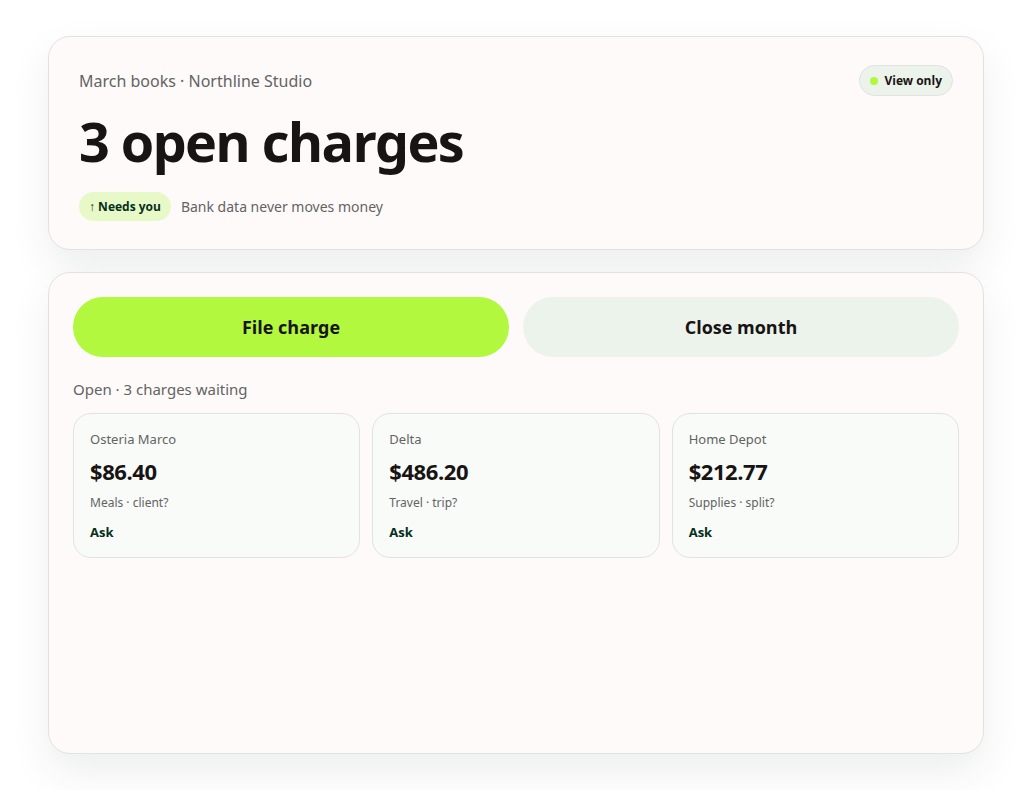
A client dinner at Osteria showed up as a $186.40 card charge. In Pruvon, that charge files to Meals. The amount stays $186.40. You are naming what the evening was for. Pruvon does not file tax returns and is not a CPA firm.
File a client dinner to Meals. The amount stays the same. Pruvon does not decide if the meal is deductible.
Why the slip looks ordinary
A $186 charge at a restaurant hits the bank feed like any other card swipe. Until you name it, the month still has an open line. Open the charge. Read the merchant and the tip. You are choosing a category, not rewriting the total. Bank data is viewed only and is never used to move money.
The merchant name shows on the bank feed.
The tip sits with the meal total.
You choose Meals as the category.
The charged amount does not change.
No money moves when you file the line.
The month stays open until the dinner has a name.
How to file it without guessing the tax rules
The tax question can wait for your accountant. Your job in Pruvon is narrower: put the dinner on Meals so the month is not left with an unnamed restaurant charge.
Open the restaurant charge in the bank feed.
Confirm the merchant name matches the dinner.
Choose Meals as the category.
Leave the tip with the meal total.
Attach the receipt if you have one.
Save without rewriting the charged amount.
Leave deductibility questions for your accountant.
Meals names the charge. It does not decide deductibility.
What this filing leaves alone
Filing to Meals does not mark the dinner as deductible, partially deductible, or personal. It does not create a receipt rule for every restaurant forever unless you save one later. It does not move cash. Pruvon is not a CPA firm and does not give tax, legal, or investment advice. Bank data is viewed only.
If you bought grocery items for the office on the same card the next day, that is a different line and a different category. Keep dinners on Meals so the month stays readable when you hand it to your accountant.
Receipts, tips, and the next restaurant charge
Match the receipt when you have one. The tip on the slip belongs with the meal total. A second dinner later in the week is a new bank line—file it to Meals again instead of editing the first charge. If you bought a gift card at the restaurant for a client, that may still sit on Meals, but read the memo; a gift card bought at an office supply store is usually not a meal.
Save a merchant rule for restaurants you use often.
Until then, open each dinner and choose Meals by hand.
Match the receipt when you have one.
Keep the tip with the meal total on that same line.
A later dinner is a new bank line—do not edit the first charge.
A grocery run on the same card is a different category.
After a few months you can save a merchant rule for a restaurant you use often. Until then, open the line and choose Meals by hand. That habit keeps the month honest when a grocery run or a software charge lands on the same card.